Why Should Anyone Care?
Part 1:
The Problem (Me): There is a crisis within the nursing field not only for students but for current nurses as well where many are quitting for several reasons. These include the stress of the workload through studying or working, the "overworked and underpaid" protests, the constant exposure to deadly diseases, and overall minimal job satisfaction due to little appreciation for their work. While many aspiring nurses believe that this career is their passion, recent events have created an imbalance of cons over pros.
Companion: You don't think you could ever really do anything about it, do you?
Me: I think that some of these dilemmas are gradually solving themselves. While COVID-19 still very much exists, the pandemic is beginning to subside and vaccinations are keeping it from spreading more, creating less deadly working environments. Furthermore, current nurses are putting their foot down and protesting through walk-out and picket lines to demand for better compensation. It's also important to keep in mind that the job of a nurse has many responsibilities and is regularly stressful.
2. Michael Pollan's main argument to care about and help solve the climate crisis is not only for virtuous reasons, but also because our contributions are much larger than they seem. Doing the right thing could encourage your friends and family to follow suit, creating a chain reaction that makes more people make efforts to save the planet. In the same way, your small efforts are related to many more solutions that you may not think of. In his example of growing your own garden, you are not only reducing your use of fertilizer in your diet, but also using your time away from entertainment consumerism, connecting with your community, exercising, conserving gas, and utilizing the abundance of solar energy. He ultimately wants people to put in what my mother says often in Spanish, "su granito de arena" (their grain of sand), towards helping the environment before our eight years run out.
3. Pollan's claim that "the deep problem standing behind all of the other problems of industrial civilization is 'specialization,'...the disease of the modern character" definitely has a lot of truth. Our society have become to dependent on leaving the hard or time-consuming stuff to the businesses. For me, I often go out to a fast-food for lunch during my breaks since I either had no time to pack a lunch before work, or I was too lazy to. Connected to that, I have become dependent of social media and streaming services for entertainment. This a large contributor to my procrastination on schoolwork, chores, or even packing a lunch! In the case of Pollan's article, the excuse many people decide not to bother caring about the environment is because we believe scientists will swoop in to help us with a new innovative invention or refined source of nonrenewable energy. However, while Pollan is quick to judge our society for these faults, he doesn't seem to acknowledge that he has done or is currently guilty of doing the same. It felt like he was putting himself on a moral pedestal and lecturing its readers to do better.
4. Okay, number four may clarify why Pollan didn't speak personally on the matters... my bad. After reading the overview for our next paper, I think I will stick with my topic on nursing dilemmas. I will plan to interview a nurse, nursing student, and others for this paper, and make sure to take careful notes on my research to avoid plagiarism!
Part 2:
The increasing number of nurses quitting in the United States are the very reasons why many aspiring nurses are quickly deciding to change their majors. Issues such as the rise is risks after the pandemic, being underpaid, or burnout are all serious problems that steering workers away. According to The Morning Consult, "19% [of nurses] have thought about leaving the health care field entirely" (Galvin). This graph shows the multitude of reasons why nurses are leaving hospitals since 2020. As a result, the ones that stayed are being burdened with even more work than before, creating a cycle of burnout that is wiping our the nurses across the country.
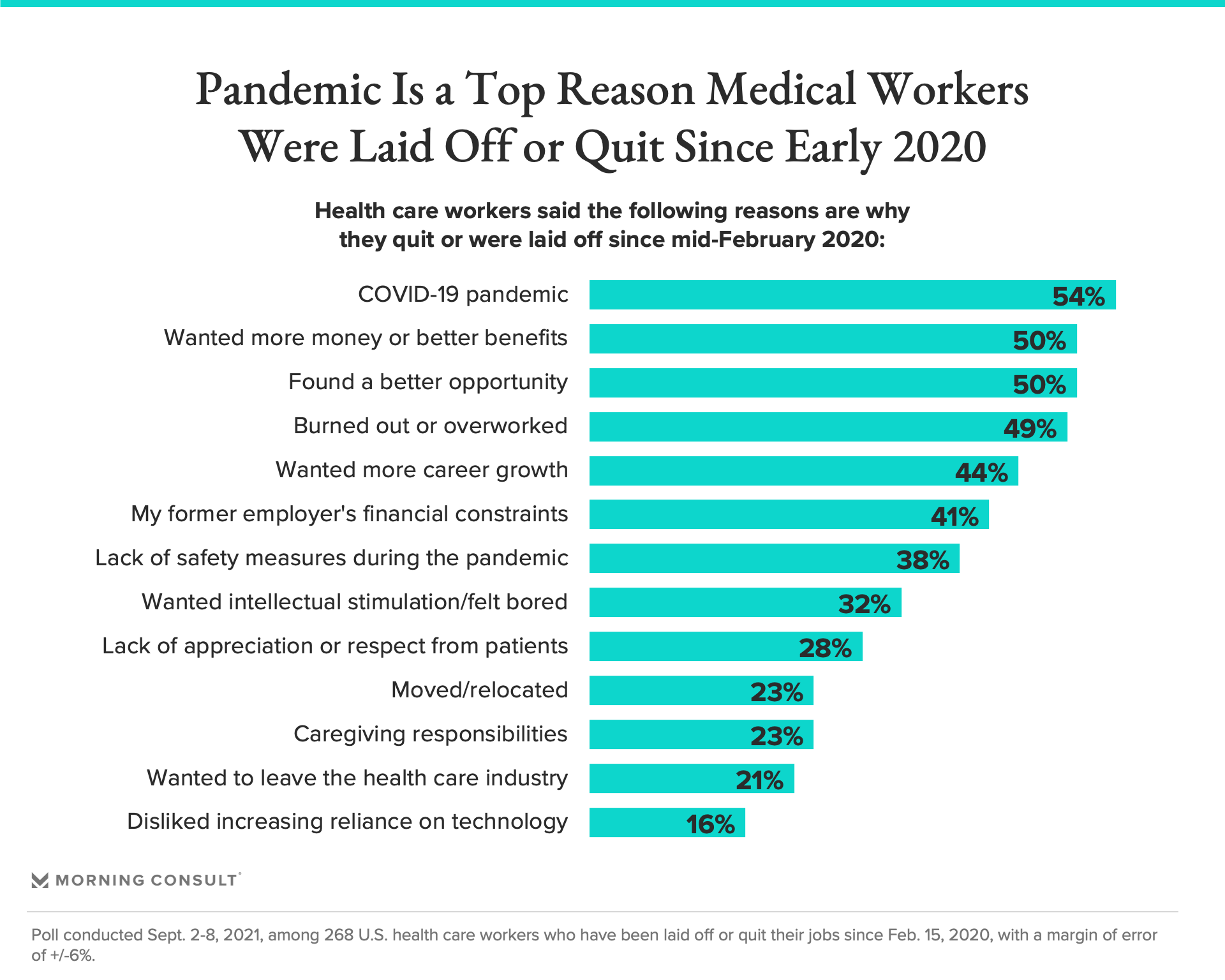
While the pandemic is subsiding, there is still feelings of being underappreciated for many nurses through their compensation and job satisfaction. This has created many protests and walk-outs of their nurses for better conditions. While there is little us as patients and civilians can do, it is important to recognize just how much nurses sacrifice and serve hospitals. So, next time you visit a hospital for whatever reason, be sure to thank your nurse and be respectful!
Galvin, Gaby. "Nearly 1 in 5 Health Care Workers Have Quit Their Jobs During the Pandemic." Morning Consult , Morning Consult, 4
Oct. 2021, morningconsult.com/2021/10/04/health-care-workers-series-part-2-workforce/.

Comments
Post a Comment